Buzzword Books - unusual, intriguing, intelligent, perceptive

Here, you'll find musings from our authors and staff. We don't promise daily updates. Just posts worth your time.

Friday, 26 July 2013

HOW TO GET WHAT YOU WANT


Martin Jensen, despite his tendency to smugness and intolerance, is the universal man. And his formidable knowledge is augmented by his partner, the fetching Dr Jensen. Their passion is effective living. Jensen's first humorous sally, How to Exercise has already been downloaded by a horde of eager eBook buffs. And his second, How to Get What you Want is now published on Buzzword.

This new book covers everything - from japes that fascinate infants to the intrigue of the Sporting Fly Swat.

It explains how to see without your specs, how to change traffic lights to green, how to dislodge rusted in screws, how to amaze small children by moving both eyes independently and even how to laugh at death.

     It even instructs on manners, sentence construction and has strategies for everything from drying between the toes to bamboozling pretentious art critics.

     What is unexpected about these sugared pills is all are practical. Beneath the humour lurks sense. And even readers intent on diversion emerge not only happier but also wiser.

     But to indulge our literary leanings, we want to include one section that deals with English expression:


How to disguise your ignorance   

We assume, that like most people, you have only a rudimentary understanding of the language and betray this to your betters whenever you speak or write.

     So we now list some of the most typical gaffes you should avoid. Then at the next garden party or when penning your CV, you will not appear so laughably crass.

     Infer and Imply. I imply something. You infer what I am saying from that implication.

     Less and fewer. Less money. Fewer coins. Less of a crowd. Fewer people. Less refers to quantity. Fewer to number.

     Unique. A thing can't be more, rather or totally unique. You can't qualify an absolute. It is either unique or not. So 'absolutely amazing', 'completely exceptional' and other bastard constructions show your ignorance.

     Never say neither. Neither is confined to the construction 'neither... nor. Similar to either... or. The word is either. To use neither is the deadest of giveaways. It confirms that you are bog Irish, illiterate, thick, and were dragged up in a hovel with nine runny-nosed siblings.

     It's adaptation, not 'adaption'.

     It's all right, not 'alright'. We refer to spelling here.

     Avoid bureaucratic language such as 'give consideration to'. Use consider. Say transport, not 'transportation'. Enough, not 'sufficient'. Begin, not 'commence' or 'initiate'. Use, not utilise. Now, not 'at this point of time'. Often, not 'frequently'. First, not initial. End, not 'conclude'. The longer word is the fear or weasel word and suggests you're afraid to say clearly what you mean.

     Simple words were good enough for Shakespeare. Hence, proactive, prestigious, hospitalisation and their ilk are to be avoided like the plague. So are clichés like the one just written. And please do not trot out 'devoutly to be wished', 'when the tumult and the shouting dies' or other such creaking borrowings. They descend like hammer blows on discriminating hearers.

     Now analyse that previous sentence. Can it be improved? As Gertrude Stein explained to Scott Fitzgerald, a sentence must not 'leak'. In other words, must not dribble off. Thus the previous sentence should read: 'They descend on discriminating hearers like hammer blows'. This is better but not ideal because the sentence was constructed to prove a point and, to provide an even finer euphonic balance should have been recast as: 'They descend like hammer blows on discriminating ears.'

     We do hope you are finding this hard-won advice germane. (Eliminate the 'do'. Remove all useless words.)

     In The King's English, (first edition 1906) the incomparable Fowler Brothers gave this still relevant advice:

     Any one who wishes to be a good writer should endeavour, before he allows himself to be tempted by the more showy qualities, to be direct, vigorous and lucid.

     This general principle may be translated into practical rules in the domain of vocabulary as follows: 

     Prefer the familiar word to the far-fetched.

     Prefer the concrete word to the abstract.

     Prefer the single word to the circumlocution.

     Prefer the short word to the long.

     Prefer the Saxon word to the Romance.


So much for Jensen on English. In case you think the book is hard going, here's another section:


How to invest

There are certain practical rules you violate at your peril. These are:

     Always sell too soon.

     Despite what every scammer tells you, no one knows what the market will do next. So avoid optimism, systems and plans.

     And, as the majority is usually wrong, only put faith in negative hunches.

     Remember that, when you finally hear the rumour, it's either designed to mislead you or it's too late to act on it. In other words, don't hop on the bandwagon. Because, by the time it heaves into view, the market manipulators have already taken their profits and you've been set up for the slippery slide.

     And remember that when interest rates rise, asset prices fall.

     As for the gnomes of Zurich, they would never diversify their assets. That, according to the experts is the way of the poor and uninformed. The experts place their funds in one sure bet and wait for it to make a killing. A risky stratagem for most. But, if you know what you're doing, far more lucrative than conventional hedging.

     Dr Jensen has invested some of her money in a Braille library that also sells kitchen-ware. Recently one of her blind subscribers mistook a nutmeg grater for a novel. When she brought it back, she complained about it bitterly - said that it had no plot and was the most violent thing she'd ever read.


Still too serious for you?  Try this:


How not to wreck a good relationship

Dr Jensen has importuned me not to include this theme in case my instinctive aversion to marriage should offend the conventionally moral. So I have promised not to comment and merely to include sayings from many lands concerning the triumph or hope over experience:

     No love so hot but marriage cools it.

     Advise none to marry or to go to war.

     Every woman should marry but no man. 

     A young man should not marry yet. An old man not at all.

     Marriage - a remedy too strong for the disease.

     Losing a wife can be hard. Often impossible.

     Marriage - an expensive way to keep warm at night.

     Monogamy, like bigamy, is having one wife too many.

     Man is incomplete till married. Then he is finished.

     You don't know what real happiness is until you get married. But then it's too late.

     'You're lucky if your wife is an angel because mine's still alive.'

     Well, enough on the ultimate tragedy.

     Except to say that marriage ignores the biological fact that monogamy is deviant behaviour. This is well expressed by a cautionary verse that should be poker-worked into each vestry door and tattooed on the forehead of every celebrant:

     Higgamus hoggamus. Woman monogamous.

     Hoggamus higgamus. Men are polygamous.

     My favourite saying on the subject is this:

     Marriage is like aviation. One is never lost. Only temporarily unsure of one's position.

     And, of course, if you don't know what to do, ask a woman and do the opposite.


And for light relief:


How to move both eyes independently.

Small children are astonished by this skill. If they think you are eccentric now, imagine how they will revere you when you blithely perform the impossible!

     Method: First cross your eyes. Now, keeping one eye crossed, move the other out to the side, as if trying to look at your ear on that side, if you have one. Then return it to the crossed position to match the other eye.      Yes, it can be done!

     Try it now in front of someone who respects you. The moment they grimace with disgust and say, 'Yuk!' you know you have succeeded. Now practise with the opposite eye to augment your ability. Remember that all worthwhile skills require application and that versatility is the essence of theatre. And that who dares, wins. And that every silver lining has a cloud.

     Truly, to meet infants on their level of fatuity is a talent that will never cease to bring you, and the other small minds you encounter, simple and abiding joy.


How to Get What you Want, now published on Buzzword, will set you back a mere 99 cents.


Saturday, 15 June 2013

Glider pilot's soaring review

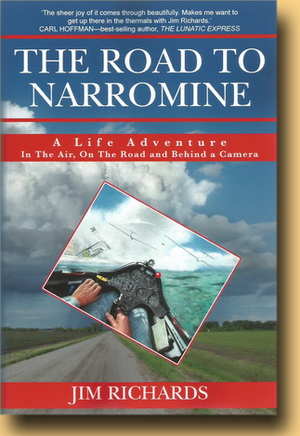
Colarado's Durago Herald has just published a very positive review by Leslie Doran on Jim Richards' memoir, The Road to Narromine - now listed on Buzzword Books. Here it is:


In a fascinating book, Durango resident Jim Richards has fashioned a narrative that is part memoir and part autobiography. Richards has been blessed with a life full of travel and adventure and along the way has had more than his share of excitement. The Road to Narromine is his story.


Richards opens the book in 1997 with a riveting, life-threatening account of an abrupt landing while soaring near Narromine, Australia. Richards captures readers’ interest with his near-death experience and then folds back and forth in time and place to share with readers his lifelong love of all things flight-related. He includes some fast land-related experiences, and about the only transportation method omitted is travel by water.

Richards’ passion for all aspects of soaring and flight leaps off the pages and is contagious. Readers will learn a lot about flying gliders, or sailplanes as they are known by professionals. In fact, Richards’ descriptions of all flying apparatus from his first sailplane flight to a ride in a T-38 jet are so detailed, especially about how each operates, that readers might feel they actually could fly each machine.

For instance, his FUST checklist that pilots run through before takeoff and landing includes flaps, undercarriage, speed and trim and explanations of each and their importance.

Richards was born in London just before the start of World War II, and some of his first memories are of the piercing sound of air-raid sirens that preceded the Nazi bombing runs on Britain.

When he was older, his father took him to a rural airfield to see the return of the “Dam Busters” who flew over Germany and blew up many dams, crippling the German war effort.

The huge planes flying overhead made another lasting impression. After the war, Richards and his parents emigrated to Canada, and at the tender age of 12, he got his first actual plane ride. The experience did nothing to excite his father, but Richards was hooked by the thrill.

Richards’ professional career started in radio as a teenager in Canada. To get to his first major job as an on-air talent, he flew again. This time, it was off to ZBM Radio in Bermuda. To feed his growing desire to fly, Richards pitched the idea of a documentary to his boss to do a series about the planes flying out of Kindley Air Force Base. He got the go-ahead from the military, and his fascination grew with each airborne experience.

Richards saw that a career in visual media was a better idea amid growing technology, and he started working as a cameraman and director of commercial advertising. This was a career choice that would take him to New York and ultimately Australia, where he finally would experience sailplanes and be hooked for life.

One of the most interesting and gripping portions of his professional experience was his use of a helicopter to get amazing shots for a commercial that took place near Ross River, Australia. The chapter “Dust II” details the origin and execution of an innovative and exciting commercial for Toyota. The unique rock formations at Ross River provided a spectacular backdrop for Richards’ vision.

At the time, technology had not developed far enough to help him get the camera shots he wanted, so Richards ended up splayed on a makeshift sling placed under the helicopter between its skids. This allowed Richards to get the smooth, close flying angles that practically put the viewer in the pilot’s seat. This was a highly dangerous and illegal action, but the resulting footage was priceless.

Richards’ book is well-written, with humor and exciting adventures played out across many continents and through a time when commercials had to be creative and painstakingly crafted without the benefit of computer modeling.

This is a great story, especially for readers interested in aircraft and flying or soaring. The mechanics Richards employed creating commercials for public consumption also is fascinating reading. The Road To Narromine is a perfect summertime read.

Leslie Doran is a Durango freelance reviewer.


Check out The Road to Narromine now. Just $3.99.

Sunday, 9 June 2013

Militant Religion - Insight or Ego?

In the Esoteric section of the Buzzword site are several books dealing with, or based on, the teaching of G. I Gurdjieff. Gurdjieff pointed out that there is a tendency for everything to slowly become its own opposite. For instance the so-called religion of love of the Christians became warped and institutionalised into an Inquisition that burned innocents at the stake. The profoundly subtle teaching of the Buddha was eventually obscured by a towering edifice of arguments of increasingly ludicrous sophistry. You may draw your own conclusions about Hinduism and suttee, Islam and suicide bombers (suicide is, we believe, forbidden by the Prophet) and other aberrations caused by narrow, self-serving interpretations of the various traditional faiths. A great faith that has been distorted for gain, or to enslave followers, (consider the almost diabolical 'sin' emphasis of the Catholic Church) is troubling to ordinary people because it cloaks its deviation. To be specific, it justifies violence with morality. 

One of our readers and correspondents, Keith Petersen - a Gurdjieff student,  a former Major in the Engineering Corps and now a Corporate Lawyer sent us this letter recently. We thought it might interest you.

The genius of the Work, as brought to us by Mr Gurdjieff, is that one may be of any religion, or none. Excluding, of course, those purportedly religious paths, such as militant Islam, that are premised on exclusivity, intolerance, and violence toward non-believers. Such paths are, of course, not religion, but merely forms of organised crime, and to call them 'religious' is to do violence to the term itself.


At the same time, the Work requires that one should be respectful of genuine belief, and not to be a militant atheist. The latter because first, atheism, being unprovable, is a kind of superstition on a par with primitive forms of religious belief, secondly, because, with its alleged foundation as a response to 'the problem of evil' , atheism represents a form of childish petulance in the face of mechanical forces, and finally, because, to judge by the behaviour observed in its adherents, it effectively elevates ego to god-like status.


Ordinary people, and those who pass for 'thinkers' are only now coming to the conclusion, obvious to any person possessing 'being-Reason',  that the essential world-conflict is not between religions, but between those people and groups with a religious attitude, in the true sense, and those whose life and outlook is based on ego, which, at its extreme justifies any action, however criminal.


I say 'conflict', but it is not a conflict to be resolved by force, but rather by persuasion, chiefly persuasion by example. In that regard, the media loves to report terrorism and crime, but the media is not interested in the no less real number of ex-terrorists, ex-criminals, who have 'repented', and who now seek to atone, and to deter others from following their former path. Such people exist.


'Religion' is thus less a matter of cosmological belief than an attitude which is characterised by humility, openness, and an ability to put oneself in the shoes of another, and, as has been said so often, to treat another as one would wish to be treated, and not as one would not wish to be treated. Compared to that, as Rabbi Hillel said, regarding the Torah, 'The rest is commentary.' That is the 'religion' which is the foundation of the paths.


Whether from the aspect of behaviour or belief, it is important to remember Mr Gurdjieff's observation, quoted in Views, that:


'At a certain level, there are no religions, there is only religion.'


Yes.


From the various paths to the summit, the views are different. From the summit itself, the view is everywhere the same.

Tuesday, 14 May 2013

The Ad Game. A former 'Mad Man' tells it like it was

Thriller writer Clinton Smith spent much of his life dreaming up ad campaigns for multinational agencies. He lived through the great days and even remembers some of them. A sample:


One morning, when I passed the office of John X, a clever and savvy copywriter, I found him standing on top of his desk.
   Standing on his desk looking down at his chair.
  In those days, all kinds of things happened in agencies. People rode Harleys through the corridors or punched their fists through the partitions. They tripped people up with their remote controlled model cars, hung newbies out the windows by their ankles, rooted each other on car bonnets in the carpark, filled rooms full of black balloons...
   So to notice someone standing on his desk was comparatively normal.
   I don't think I asked him directly what ailed him but I was curious.
   Then someone filled me in.
   The guy was working on proposition for a cigarette campaign. I'll try to unpack that for you.

The proposition

This particular agency had a department that developed selling propositions. It's job was to assemble the bare bones of a selling statement or six, research the hell out of them, then present the winner to the creative department.
   For instance, the winning proposition, authenticated by scores of well-compensated housewives selected from all three socio-economic groups (they love that kind of language) might be 'OMO has more effective bleaching agents'. The creative department would then translate this into 'OMO has blue beads of bleach'. Of course, that wouldn't be the entire
execution, or even the slogan, but it might just kick off a TV campaign.
   So this guy was working on a coffin-nail brand. (We were allowed to in those days.) And the proposition they'd given him was: 'The man who smokes Brand X is taller than anyone else in the room.'
   As my fellow creative could recognise insanity when he saw it, he knew that the Proposition Department had vanished up it's collective arse. So, after standing on his desk for a couple of days, he told them to shove their notion up there as well - and went on to a distinguished career in several less constipated agencies.

Famous in our own lunchtimes

Those were the practically free lunch days because expense accounts were claimable. So you'd wipe yourself out with the most expensive lunch and not look in on the office after that - because, by then, you were staggering drunk.
   Of course you'd drive home (no breath tests) at considerable speed, barely able to discern the steering wheel, let alone the traffic around you. We lost several Account Executives to fatal car accidents. One moment someone was there - young, fit and full of life and hope. The next day he didn't come in and you learned that he'd gone under the back of a semi-trailer, or rolled his Merc on a business junta in Malaysia.

Write yourself a trip!

And, on the weekend off, we took a meandering trip around the Amalfi Coast.
     I remember that trip. The director - a wild man - and the client (who came along for the fun) decided that we had to go to Positano. So we assembled ready to roll. I packed an overnight bag containing two pairs of underpants, two handkerchiefs, toothbrush et al. The client turned up with nothing - just a toothbrush stuck in his top pocket. As for the director - fazed from a night with some girl he'd found (He said he'd drunk her pretty) - he had what he stood up in.
   The client said to him, 'Aren't you taking your toothbrush?'
   The director said, 'F*%-knell! You can buy a toothbrush anywhere!'

Tooling around Europe

Another shoot involved driving and filming a new Renault model in Paris, the South of France and Monaco. The first day was fraught. We were working with a skeleton crew and I had to collect the car from the Renault factory, and drive it to the Arch de Triumph where the male and female talent were to hop in and circle the damned thing, looking cool.
    Simple enough if you've ever driven a left hand drive car on the wrong side of the road in a traffic-jammed foreign city. I hadn't. And bending the car wasn't an option. We only had the one prototype. As it happened, luck was with me. But the whole shoot could have gone up the spout right there.

Mountain Climbing in NZ

Then there was the aftershave shoot in New Zealand. We wanted to film hang-gliders taking off from mountains in the Aspirings and soaring above the snow-clad peaks. All good. Except when you are suddenly choppered up 3,300 metres and have to lug heavy camera cases to the peak through deep snow, it's not easy to breathe.
   But did those two hang-glider fliers get lucky! For days, they were flown to the top of the mountain, took off, flew like birds then landed in the valley, followed by the ever attentive chopper. It waited for the glider to be repacked and strapped to the skids, then flew them up to the top again for another go. All day for days. There was no way those two young guys could ever have afforded such a gig themselves. To use a contemporary expression, they were stoked! And, by the way, you don't shut down a chopper when you perch it on the top of a mountain. Because if you can't get it started again, it's cactus. So all day, for days, that chopper, when not actually flying, sat on a peak and chugged.

The industry and the agony!

There were tragic moments, too.
   For instance, they say never work with children or animals. But what if you're doing a cat commercial and need pussy to bound across the floor and lick his pretty owner's ears?
   Well it can be quite simple if you put enough fish-paste in her ears.
   But on the other hand, you could be there all day doing take 85 of a five shot commercial.
   Once my TV producer, a hard-bitten woman, and I took the afternoon off to see a movie. We went to Truffaut's 'Day For Night' - a wonderful exposition of what it takes to make a film. At one stage in that masterpiece, they have the street is all blocked off. They have great banks of floods and reflectors, spots on scaffolds, trucks everywhere - gaffer trucks, catering, grip, generator - the whole catastrophe. They have a camera on a crane, dollys on tracks and fifty anxious crew. And, in the middle of it all, they're trying to get a cat to drink its milk.
   And the cat will not drink its milk!
   Despite the enormous forces assembled, despite endless patient coaxing, nothing anyone can do can make the damned cat drink its milk.
   My agency producer and I sat in that darkened, almost empty theatre and sobbed. And why did we case-hardened ad types sit there bawling? Because, in one seminal scene, Truffaut had crystallised the anguish we had lived so often, had captured the nobility and tragedy of the process.
   Looking back, it was the best of times and worst. And only a fool would want to live it again.
   In fact, you can't.
   The Internet has cut the meat out of the media buy. Audiences are becoming so dispersed that simple access to them is gone.
   God knows how agencies cut it now. And he's welcome to the information.

You'll find five of Clint's thrillers on Buzzword.

Tuesday, 30 April 2013

HOW MANY FRENCH SOLDIERS DOES IT TAKE TO DEFEND PARIS?

We recently published Ray Johnstone's All Fall Down - a remarkable account of two young boys growing up in occupied France. This thoughtful, well-researched work, perceptively conceived, brilliantly evokes the atmosphere of the period.  We asked Ray to contribute to the blog - which he has done in typically thorough fashion. So! How many French soldiers does it take?


Because of the invasion of Iraq, most people know the answer to this question, but before I respond to it for those who don’t, let’s go back a few steps to 1914.
    It is now almost a century since an assassination in the Balkans triggered World War I. For convoluted reasons understood by very few these days, within weeks mankind was enmeshed in a worldwide conflict that resulted in destruction and death on an unprecedented scale. Four terrible years later, the Armistice was signed and the cliché that this had been the ‘the war to end wars’ was introduced into the language. But within a few short years the League of Nations failed and the political and diplomatic manoevering in Europe’s capitals once again became difficult to follow. Eventually appeasement was abondoned and brinkmanship became a thing of the past as most countries prepared for another war.
    But in France, large sections of the population tried to ignore these developments. The overwhelming majority was hoping against hope to avoid repeating the nightmare of the Great War which killed over one and a half million French citizens. The carnage, it is said, touched every family in France.
    The promise of peace finally proved to be a lie when Parisians noticed telltale smoke plumes rising over public buildings as beaurocrats burned their sensitive documents. Then the government abondoned Paris for Bordeaux.
    When the blitzkrieg came it was so fast that there were almost no pitched battles. The French army resisted  for a while, then it faltered, crumbled and was finally routed. A few weeks later the Fuhrer went on a triumphant tour of Paris and the long, dark days of occupation began.


The War Memorial

Even the tiniest hamlet in France has its monument aux morts or war memorial, with a list of names of those who died in each World War. The same applies to Australia where every city, town and village has a monument with a Role of Honour to commemorate Australian deaths in the two conflicts. But in France the World War Two list is always much shorter because the war itself was short. The French army capitulated in little more than six weeks and those who died as martyrs of the resistance - or in deportation - always outnumber those killed in action - and often by a considerable margin.
    The idea for ‘All Fall Down’ first came to me when I stumbled across a nondescript grave near my home in Gascony. It marks the spot where a young boy was shot by the departing Germans just a few months before the war ended. I felt confounded that such barbarity could have taken place in this idyllic part of France little over sixty years ago.
    As an Australian I am aware of the widespread feeling that France took the soft option by capitulating so quickly in the wake of the blitzkrieg. But the longer I live in France, the more I realise how terrible the years of occupation were. So I decided to start researching and writing a novel for English speaking readers in an effort to try and put the record straight.
    Although my book is a work of fiction, everything (well almost) is based on actual events. Several of the incidents were described to me by older French people I have met - some are taken from descriptions I have found in resistance museums and on war memorials - and others are from books, magazine and newspaper reports I have rooted out. The result (I hope) is a graphic, crude and violent novel, without a jot of romanticism.
    The twin themes of the story are, I suppose, collaboration and resistance. These are complicated issues, and there were many shades of both. For those of us - like me - who have never lived in an occupied country, they can be especially difficult ideas to unravel. Active resistance was certainly a long time coming, and during those bleak and frightening years, the primary objective of millions of French citizens was to simply keep their heads down and to get on with their lives. But through some of the fictionalized events described, I hope I have been able to provide an insight into how complex and dangerous living through the dark years of Nazi occupation was for the people of France.


A Finished Book?

Ten years later I felt that ‘All Fall Down’ was finished.
    But it wasn’t. 
    J.K. Rowlings is quoted as saying that she became rather depressed when her first Harry Potter book was rejected by so many publishers. Twelve, apparently. Well,  All Fall Down has been rejected or ignored by a few more than that. My estimate is that a thousand publishers and/or agents responded to my submissions with a deafening silence.
    But luckily one day when I had long given up the idea of getting my book published, I stumbled across the Buzzword Books website and read Dan Mills’s no holds barred blog. It pulls no punches on the subjects of writing (and rewriting and rewriting) and the almost negligible possibilities of ever finding a publisher - let alone ever making any money out of writing. It is probably best summed up with the line: 'All of us are doomed to obscurity,' but I decided to give it another try (taking my submission total to one thousand and one).
    Fortunately for me, something clicked, and an email followed suggesting that I, wait for it, yes, rewrite the manuscript (with certain changes) for further consideration by Buzzword.
    So it was back to the starting point with many revisions and several more drafts. But the lapse in time allowed me to see all kinds of problems in the original manuscript I had not noticed before. During this rewriting, I saw things with new eyes and I was able (sometimes with considerable pain) to jettison many overwritten passages, lots of turgid stuff and long slabs of unnecessary, self indulgent writing.
    Then (wow! out of the blue) Buzzword Books eventually deemed it ready for publication.


In war, there are no winners

But what about the question of French soldiers defending the French capital? Well, the answer, as most Americans and other Anglo Saxons know points back to Paris under Nazi occupation: no one knows because it’s never been done before.
    Jokes like this abound in the United States and most English speaking countries because of the widespread impression that France gave up too early and too eagerly when the Germans attacked in 1940 - and because France refused to support the allied invasion of Iraq in 2003.
    But, as George Orwell pointed out, the quickest way to end a war is to lose it.
    In war there are no winners, and to illustrate this, in All Fall Down, good does not triumph over evil. The price for treachery is seldom exacted, and brutality is meted out equally on both sides in the struggle for Liberation.
    Although my sympathies are categorically and wholeheartedly with the French, it is folly to believe that evil attaches itself exclusively to one side in any conflict.
    So without belabouring the point, I hope the unrelenting anti-war theme, as well as the idea that prejudice is universal, come through loud and clear.


The Triumph of Evil

The subtitle I chose for All Fall Down is The Triumph of Evil. This is because I do not believe that much has changed since the end of the First World War.
    Although in the West living conditions and wealth have improved dramatically for many over the last hundred years, to this day, much of the third world still lives in poverty or on the cusp of starvation. Racial and gender equality remain a dream for most, and crimes against women, gays and other minorities often go unpunished. Almost all countries have governments that are, in some way, manipulative, corrupt, suppressive or undemocratic - and the electorates in many have lost confidence in the political process. Class, tribal and ethnic conflicts are endemic. Religious intolerance is rife. Terrorist acts are universal. The taking, torture and execution of hostages is commonplace and from China to the United States the death penalty is either tolerated or condoned. In some countries it is even popular.
    So now, still in the ascendancy nearly one hundred years since the war that was fought to end all wars, it seems that evil has triumphed.

RJ Mezin April 2013
ray@johnstonesinfrance.com


Read more about All Fall Down here. Just $3.95

Monday, 18 March 2013

How to Write a Thriller

Thriller writer, Clinton Smith, has written down a checklist that he refers to when he writes his thrillers. You can download five of his books from the Buzzword site. His list is compiled from advice from his early mentors - an exceptional editor and a best selling crime writer. It's very short. But, for what it's worth, here it is. (For the uninitiated, POV means Point of View):


* REMAIN IN THE PRESENT.  FLASHBACKS ARE DEADLY. Delete all possible. Best way to show characters is to put them in a situation that brings out their qualities - an incident that shows them all as they are - a forced landing for instance.  Private conversations should be overheard by Hero. (The less you know of the villain's POV, the more mysterious he is.)


* LIMIT POV TO VICTIMS


* DO IT ON THE TOP STORY. A CHARACTER NEEDS TO TAKE US BY THE HAND AND LEAD US THROUGH THE STORY. Events from Hero's POV because he has gone or been ordered to places and sees them.


* HERO NOT JUDGEMENTAL.

* Hero forced to participate in order to survive.

*  WHAT HAPPENS NEXT? GOOD NARRATIVE WRITING ALWAYS DRIVES FORWARD. NEEDS PAGE TURNING QUALITY.

   
*  EACH CHAPTER MUST ADVANCE THE PLOT.

*  INTEREST MUST BE MAINTAINED. WITHHOLD INFORMATION. We gradually learn details of character's past histories.

*  Don't be predictable.

*  SHOW. DON'T TELL. If character is a drunk, don't say it, show him getting drunk, let's smell his breath.

*  DON'T INTRODUCE TOO MANY CHARACTERS TOO FAST. The rule is one per chapter in ordinary (not thriller style) fiction.  In suspense writing they can be used only when the reader is hooked beyond recall.

*  BE BELIEVABLE. PEOPLE MUST SEEM REAL.

*  DELETE REPETITIOUS DESCRIPTION OF CHARACTERS.

*  Include well researched facts for authenticity.(Check research with those who know.)

*  SPLIT CHAPTERS. Shorter chapters work.
   
*  TOO MANY ADJECTIVES - LEANER. Remove all surplus adjectives as well as the 'rather's the 'quite's, the 'very's and so on. Also attention to prolixity, overused words.
   
*  DIALOGUE NEEDS 'EDGE'.  READ DIALOGUE ALOUD.  NO QUOTATIONS. Tell the story through dialogue.  But not dialogue that is cosy, coy or wordy.  Three word speeches. Cut dialogue to the bone. 'Flip comments don't usually come off.  They divert the reader and interfere with the building of tension'. 'Don't leave out subject of the verb too often'. 'Don't show off'. DON'T PHILOSOPHISE IN DIALOGUE.

*  Flesh out a pleasantly labyrinthine and complex 'nasty' plot studded with apparently informed facts about a number of subjects, professions and locations which provides 'intelligent escapism'. 'Lively superficial entertainment.'

*  Belt out the first draft.  Get it all down on paper, then revise by cutting scenes, rounding out characters, adding

*  LESS IS MORE.

*  STORY MUST BE 'TIGHT, HARD, FAST, TERSE, HOT, DIRTY, TENSE.' 'Have a short, sharp, nasty way of writing violence.' Hard energy.
 

*  WATCH BALANCE AND WEIGHTING.  More on action, less on dog food.

*  Only break unity of place if it is a natural act 2.

So there you have it. The essentials. The good guts - from someone who knows. And if you want a real treat, download Smith's latest - PROJECT THUNDER from Buzzword. Just $3.99.

Friday, 1 March 2013

Commentary on the Gurdjieff Work


Among Rosicrucian and Hermetic scholar, Joy Lonsdale's papers, we found copious notes originally written to another writer in the field as a commentary on his new book on Gurdjieff's Work. We have abstracted some of the more general comments here. 

No, we don't really wish to know and accept that transformation and freedom are very hard to achieve. We like to feel it should be easy. Therefore, it doesn't help us in any way to imagine that anyone at all had it easy (the condition messengers from above must enjoy, who did not feel like this, but had a future of bliss assured them! Ordinary human beings don't have such assurances). Gurdjieff suffered, like most humans, physical and no doubt emotional pain, death of loved ones, failures, financial and otherwise, frustrations, ill will towards him, insults, treachery, jealousies, etc. etc. I think this is why people can relate to him - he was so human! As he said himself, he's not only been through the mill, but even through all the grindstones!

p.46. There are many who would say that G's cosmology was just another theory, among others. I do not believe he has laid bare in his writings all the secrets of everything you've mentioned. If, as I believe, he was an Hermeticist he would have been under oath not to do so anyway, and it's why he wrote allegorically. I have come to learn that it is not wise to put all our faith in any one theory, or line of thought, but to leave our minds open to all possibilities, provided they make sense and are not too fantastic. G's Ray of Creation is a wonderful portrayal of the way things could have occurred, not necessarily how they actually did occur, for who can know this anyway?

p.56. I tell people that Gurdjieff was a Rosicrucian! Not that I equate him with what currently passes for this word in its outer garb, but definitely with its older and inner meaning. And yes, I agree that the Fourth Way IS a Rosicrucian manifestation, as you say, for they, the real masters, by whatever name they are called at any time, go underground periodically and resurface under a new guise. I think it's ever been thus. R.N. feels that there never was any real Exodus of the Jewish race, but rather it was an exodus of the Jews (allegorical for initiates) from Heliopolis when Egypt was overrun. G himself predicted that his teaching would go full circle, and then retreat for a time. And I remember that P.O. said that a conscious teaching was not under the law of recurrence, so that if we met it once we may not meet it again so all the more reason to work now.

p.68. Can't agree with you that a really free attention is the desired state. The attention must be captured, fixed and then controlled through the will-power, when it becomes one-pointed concentration. Mercury represents the attention, and with his winged sandals plays a double role. He is the agent, or messenger, of the subconscious, but also becomes a fugitive servant, forgetting his real master and becoming a plaything for all the caprices of the conscious mind, a real will-o'-the-wisp. It is why the old alchemists said one must work with the right type of mercury to succeed. Let's not forget, too, that Mercury wore a helmet, symbolic of invisibility (for the attention is not a visible manifestation) and his winged sandals show his duality. His wings have to be clipped - in one myth he was even threatened with having his feet cut off - both of these showing he has to be grounded and his freedom taken away from him so he will work more constructively. It says something about our general state of inattention that it does not appear anywhere in myth that Mercury was ever so grounded!

p.78. You obviously believe in reincarnation. It's the one aspect of the Rosicrucian teaching (or any other) with which I can't concur! And did G ever expound it? As I remember he seems to have said that only fully conscious men can reincarnate and as these would be very few, it seems he meant it was not a general occurrence. I favour Ouspensky's eternal recurrence (and he stated that he got confirmation of this from G, albeit in a roundabout sort of way). I feel it is more orderly, and it makes much more sense to me, and (provided one can understand what it means) I think it gives the possibility to everyone to change if they awaken. (P.O. said no, there are some who have to play the same role over and over.) I feel we are wheels within wheels within wheels, and we can go round and round on the same one for however long eternity may be - as P.O. said himself, there is a real death and an end to it if one never makes the effort to change. The possibilities get less and less each recurrence until they eventually run out, or it may follow the Law of Seven and we only get seven chances, but who knows this for sure?