Buzzword Books - unusual, intriguing, intelligent, perceptive

Here, you'll find musings from our authors and staff. We don't promise daily updates. Just posts worth your time.

Tuesday, 30 April 2013

HOW MANY FRENCH SOLDIERS DOES IT TAKE TO DEFEND PARIS?

We recently published Ray Johnstone's All Fall Down - a remarkable account of two young boys growing up in occupied France. This thoughtful, well-researched work, perceptively conceived, brilliantly evokes the atmosphere of the period.  We asked Ray to contribute to the blog - which he has done in typically thorough fashion. So! How many French soldiers does it take?


Because of the invasion of Iraq, most people know the answer to this question, but before I respond to it for those who don’t, let’s go back a few steps to 1914.
    It is now almost a century since an assassination in the Balkans triggered World War I. For convoluted reasons understood by very few these days, within weeks mankind was enmeshed in a worldwide conflict that resulted in destruction and death on an unprecedented scale. Four terrible years later, the Armistice was signed and the cliché that this had been the ‘the war to end wars’ was introduced into the language. But within a few short years the League of Nations failed and the political and diplomatic manoevering in Europe’s capitals once again became difficult to follow. Eventually appeasement was abondoned and brinkmanship became a thing of the past as most countries prepared for another war.
    But in France, large sections of the population tried to ignore these developments. The overwhelming majority was hoping against hope to avoid repeating the nightmare of the Great War which killed over one and a half million French citizens. The carnage, it is said, touched every family in France.
    The promise of peace finally proved to be a lie when Parisians noticed telltale smoke plumes rising over public buildings as beaurocrats burned their sensitive documents. Then the government abondoned Paris for Bordeaux.
    When the blitzkrieg came it was so fast that there were almost no pitched battles. The French army resisted  for a while, then it faltered, crumbled and was finally routed. A few weeks later the Fuhrer went on a triumphant tour of Paris and the long, dark days of occupation began.


The War Memorial

Even the tiniest hamlet in France has its monument aux morts or war memorial, with a list of names of those who died in each World War. The same applies to Australia where every city, town and village has a monument with a Role of Honour to commemorate Australian deaths in the two conflicts. But in France the World War Two list is always much shorter because the war itself was short. The French army capitulated in little more than six weeks and those who died as martyrs of the resistance - or in deportation - always outnumber those killed in action - and often by a considerable margin.
    The idea for ‘All Fall Down’ first came to me when I stumbled across a nondescript grave near my home in Gascony. It marks the spot where a young boy was shot by the departing Germans just a few months before the war ended. I felt confounded that such barbarity could have taken place in this idyllic part of France little over sixty years ago.
    As an Australian I am aware of the widespread feeling that France took the soft option by capitulating so quickly in the wake of the blitzkrieg. But the longer I live in France, the more I realise how terrible the years of occupation were. So I decided to start researching and writing a novel for English speaking readers in an effort to try and put the record straight.
    Although my book is a work of fiction, everything (well almost) is based on actual events. Several of the incidents were described to me by older French people I have met - some are taken from descriptions I have found in resistance museums and on war memorials - and others are from books, magazine and newspaper reports I have rooted out. The result (I hope) is a graphic, crude and violent novel, without a jot of romanticism.
    The twin themes of the story are, I suppose, collaboration and resistance. These are complicated issues, and there were many shades of both. For those of us - like me - who have never lived in an occupied country, they can be especially difficult ideas to unravel. Active resistance was certainly a long time coming, and during those bleak and frightening years, the primary objective of millions of French citizens was to simply keep their heads down and to get on with their lives. But through some of the fictionalized events described, I hope I have been able to provide an insight into how complex and dangerous living through the dark years of Nazi occupation was for the people of France.


A Finished Book?

Ten years later I felt that ‘All Fall Down’ was finished.
    But it wasn’t. 
    J.K. Rowlings is quoted as saying that she became rather depressed when her first Harry Potter book was rejected by so many publishers. Twelve, apparently. Well,  All Fall Down has been rejected or ignored by a few more than that. My estimate is that a thousand publishers and/or agents responded to my submissions with a deafening silence.
    But luckily one day when I had long given up the idea of getting my book published, I stumbled across the Buzzword Books website and read Dan Mills’s no holds barred blog. It pulls no punches on the subjects of writing (and rewriting and rewriting) and the almost negligible possibilities of ever finding a publisher - let alone ever making any money out of writing. It is probably best summed up with the line: 'All of us are doomed to obscurity,' but I decided to give it another try (taking my submission total to one thousand and one).
    Fortunately for me, something clicked, and an email followed suggesting that I, wait for it, yes, rewrite the manuscript (with certain changes) for further consideration by Buzzword.
    So it was back to the starting point with many revisions and several more drafts. But the lapse in time allowed me to see all kinds of problems in the original manuscript I had not noticed before. During this rewriting, I saw things with new eyes and I was able (sometimes with considerable pain) to jettison many overwritten passages, lots of turgid stuff and long slabs of unnecessary, self indulgent writing.
    Then (wow! out of the blue) Buzzword Books eventually deemed it ready for publication.


In war, there are no winners

But what about the question of French soldiers defending the French capital? Well, the answer, as most Americans and other Anglo Saxons know points back to Paris under Nazi occupation: no one knows because it’s never been done before.
    Jokes like this abound in the United States and most English speaking countries because of the widespread impression that France gave up too early and too eagerly when the Germans attacked in 1940 - and because France refused to support the allied invasion of Iraq in 2003.
    But, as George Orwell pointed out, the quickest way to end a war is to lose it.
    In war there are no winners, and to illustrate this, in All Fall Down, good does not triumph over evil. The price for treachery is seldom exacted, and brutality is meted out equally on both sides in the struggle for Liberation.
    Although my sympathies are categorically and wholeheartedly with the French, it is folly to believe that evil attaches itself exclusively to one side in any conflict.
    So without belabouring the point, I hope the unrelenting anti-war theme, as well as the idea that prejudice is universal, come through loud and clear.


The Triumph of Evil

The subtitle I chose for All Fall Down is The Triumph of Evil. This is because I do not believe that much has changed since the end of the First World War.
    Although in the West living conditions and wealth have improved dramatically for many over the last hundred years, to this day, much of the third world still lives in poverty or on the cusp of starvation. Racial and gender equality remain a dream for most, and crimes against women, gays and other minorities often go unpunished. Almost all countries have governments that are, in some way, manipulative, corrupt, suppressive or undemocratic - and the electorates in many have lost confidence in the political process. Class, tribal and ethnic conflicts are endemic. Religious intolerance is rife. Terrorist acts are universal. The taking, torture and execution of hostages is commonplace and from China to the United States the death penalty is either tolerated or condoned. In some countries it is even popular.
    So now, still in the ascendancy nearly one hundred years since the war that was fought to end all wars, it seems that evil has triumphed.

RJ Mezin April 2013
ray@johnstonesinfrance.com


Read more about All Fall Down here. Just $3.95

Monday, 18 March 2013

How to Write a Thriller

Thriller writer, Clinton Smith, has written down a checklist that he refers to when he writes his thrillers. You can download five of his books from the Buzzword site. His list is compiled from advice from his early mentors - an exceptional editor and a best selling crime writer. It's very short. But, for what it's worth, here it is. (For the uninitiated, POV means Point of View):


* REMAIN IN THE PRESENT.  FLASHBACKS ARE DEADLY. Delete all possible. Best way to show characters is to put them in a situation that brings out their qualities - an incident that shows them all as they are - a forced landing for instance.  Private conversations should be overheard by Hero. (The less you know of the villain's POV, the more mysterious he is.)


* LIMIT POV TO VICTIMS


* DO IT ON THE TOP STORY. A CHARACTER NEEDS TO TAKE US BY THE HAND AND LEAD US THROUGH THE STORY. Events from Hero's POV because he has gone or been ordered to places and sees them.


* HERO NOT JUDGEMENTAL.

* Hero forced to participate in order to survive.

*  WHAT HAPPENS NEXT? GOOD NARRATIVE WRITING ALWAYS DRIVES FORWARD. NEEDS PAGE TURNING QUALITY.

   
*  EACH CHAPTER MUST ADVANCE THE PLOT.

*  INTEREST MUST BE MAINTAINED. WITHHOLD INFORMATION. We gradually learn details of character's past histories.

*  Don't be predictable.

*  SHOW. DON'T TELL. If character is a drunk, don't say it, show him getting drunk, let's smell his breath.

*  DON'T INTRODUCE TOO MANY CHARACTERS TOO FAST. The rule is one per chapter in ordinary (not thriller style) fiction.  In suspense writing they can be used only when the reader is hooked beyond recall.

*  BE BELIEVABLE. PEOPLE MUST SEEM REAL.

*  DELETE REPETITIOUS DESCRIPTION OF CHARACTERS.

*  Include well researched facts for authenticity.(Check research with those who know.)

*  SPLIT CHAPTERS. Shorter chapters work.
   
*  TOO MANY ADJECTIVES - LEANER. Remove all surplus adjectives as well as the 'rather's the 'quite's, the 'very's and so on. Also attention to prolixity, overused words.
   
*  DIALOGUE NEEDS 'EDGE'.  READ DIALOGUE ALOUD.  NO QUOTATIONS. Tell the story through dialogue.  But not dialogue that is cosy, coy or wordy.  Three word speeches. Cut dialogue to the bone. 'Flip comments don't usually come off.  They divert the reader and interfere with the building of tension'. 'Don't leave out subject of the verb too often'. 'Don't show off'. DON'T PHILOSOPHISE IN DIALOGUE.

*  Flesh out a pleasantly labyrinthine and complex 'nasty' plot studded with apparently informed facts about a number of subjects, professions and locations which provides 'intelligent escapism'. 'Lively superficial entertainment.'

*  Belt out the first draft.  Get it all down on paper, then revise by cutting scenes, rounding out characters, adding

*  LESS IS MORE.

*  STORY MUST BE 'TIGHT, HARD, FAST, TERSE, HOT, DIRTY, TENSE.' 'Have a short, sharp, nasty way of writing violence.' Hard energy.
 

*  WATCH BALANCE AND WEIGHTING.  More on action, less on dog food.

*  Only break unity of place if it is a natural act 2.

So there you have it. The essentials. The good guts - from someone who knows. And if you want a real treat, download Smith's latest - PROJECT THUNDER from Buzzword. Just $3.99.

Friday, 1 March 2013

Commentary on the Gurdjieff Work


Among Rosicrucian and Hermetic scholar, Joy Lonsdale's papers, we found copious notes originally written to another writer in the field as a commentary on his new book on Gurdjieff's Work. We have abstracted some of the more general comments here. 

No, we don't really wish to know and accept that transformation and freedom are very hard to achieve. We like to feel it should be easy. Therefore, it doesn't help us in any way to imagine that anyone at all had it easy (the condition messengers from above must enjoy, who did not feel like this, but had a future of bliss assured them! Ordinary human beings don't have such assurances). Gurdjieff suffered, like most humans, physical and no doubt emotional pain, death of loved ones, failures, financial and otherwise, frustrations, ill will towards him, insults, treachery, jealousies, etc. etc. I think this is why people can relate to him - he was so human! As he said himself, he's not only been through the mill, but even through all the grindstones!

p.46. There are many who would say that G's cosmology was just another theory, among others. I do not believe he has laid bare in his writings all the secrets of everything you've mentioned. If, as I believe, he was an Hermeticist he would have been under oath not to do so anyway, and it's why he wrote allegorically. I have come to learn that it is not wise to put all our faith in any one theory, or line of thought, but to leave our minds open to all possibilities, provided they make sense and are not too fantastic. G's Ray of Creation is a wonderful portrayal of the way things could have occurred, not necessarily how they actually did occur, for who can know this anyway?

p.56. I tell people that Gurdjieff was a Rosicrucian! Not that I equate him with what currently passes for this word in its outer garb, but definitely with its older and inner meaning. And yes, I agree that the Fourth Way IS a Rosicrucian manifestation, as you say, for they, the real masters, by whatever name they are called at any time, go underground periodically and resurface under a new guise. I think it's ever been thus. R.N. feels that there never was any real Exodus of the Jewish race, but rather it was an exodus of the Jews (allegorical for initiates) from Heliopolis when Egypt was overrun. G himself predicted that his teaching would go full circle, and then retreat for a time. And I remember that P.O. said that a conscious teaching was not under the law of recurrence, so that if we met it once we may not meet it again so all the more reason to work now.

p.68. Can't agree with you that a really free attention is the desired state. The attention must be captured, fixed and then controlled through the will-power, when it becomes one-pointed concentration. Mercury represents the attention, and with his winged sandals plays a double role. He is the agent, or messenger, of the subconscious, but also becomes a fugitive servant, forgetting his real master and becoming a plaything for all the caprices of the conscious mind, a real will-o'-the-wisp. It is why the old alchemists said one must work with the right type of mercury to succeed. Let's not forget, too, that Mercury wore a helmet, symbolic of invisibility (for the attention is not a visible manifestation) and his winged sandals show his duality. His wings have to be clipped - in one myth he was even threatened with having his feet cut off - both of these showing he has to be grounded and his freedom taken away from him so he will work more constructively. It says something about our general state of inattention that it does not appear anywhere in myth that Mercury was ever so grounded!

p.78. You obviously believe in reincarnation. It's the one aspect of the Rosicrucian teaching (or any other) with which I can't concur! And did G ever expound it? As I remember he seems to have said that only fully conscious men can reincarnate and as these would be very few, it seems he meant it was not a general occurrence. I favour Ouspensky's eternal recurrence (and he stated that he got confirmation of this from G, albeit in a roundabout sort of way). I feel it is more orderly, and it makes much more sense to me, and (provided one can understand what it means) I think it gives the possibility to everyone to change if they awaken. (P.O. said no, there are some who have to play the same role over and over.) I feel we are wheels within wheels within wheels, and we can go round and round on the same one for however long eternity may be - as P.O. said himself, there is a real death and an end to it if one never makes the effort to change. The possibilities get less and less each recurrence until they eventually run out, or it may follow the Law of Seven and we only get seven chances, but who knows this for sure?

Tuesday, 8 January 2013

Buddhism, Vedanta, Sufism, Christianity, Taoism, the Gurdjieff Work, Zen... What is the hidden secret behind all the world's great teachings and religions?

Most religions tell you what to do but not how to do it. Because, over the ages, the inner knowledge they once had and understood has been forgotten, distorted or conveniently supressed.
  John Alexandra strips the mould, dogma and obfuscation from the great sources of spiritual insight - and uses two in particular - the Gurdjieff Work and Zen - to open the frontiers to unitary knowledge in a profoundly simple and genuine way.

Author, John Alexandra, has studied with both the Zen and Gurdjieff traditions and is an expert on comparative religion. His intention here is to synthesize both eastern and western approaches for sincere minds who have always been troubled by the apparent differences between them. This deceptively simple book addresses the heart of the seeker's confusion then disinters the profound truth behind all systems of transformation
. We thought you might like to read the introduction from this revealing study:


Introduction'There is no solution. Because there is no problem.'
Marcel Duchamp

'Let nowhere abide and generate the Mind.'

Diamond Sutra

'Why do you prate of God? Don't you know that whatever you say of him is untrue?'

Meister Eckhart

''To know means to know all.
To know a part of something means not to know.
It is not difficult to know all, because in order to know all
one has to know very little.
But in order to know that little, one has to know pretty much.'

G. I. Gurdjieff

It can take a lifetime to understand that little - to realise a few simple things.
  What is the nature of reality? And can it be directly known? Through the ages, mystics have said that it can. Although their experiences are identical, because Unity is one, their expressions for it are myriad, because truth can't be defined in words. And so all such expressions attempt to describe the same thing.
  The Cloud of Unknowing.
  The Unmoved Mover who moves all things.
  The Void.
  The Silence.
  The Stillness.
  The Original Face.
  The Absolute.
  The Great Mind.
  The Now.
  Intrinsic Being.
  The I AM...
  And can we flawed, undisciplined beings ever aspire to know this thing - not philosophically but organically. Can we know it with certainty - as fact?
  Through the ages, there are always people who preserve the approach to unitive knowledge - people in touch with more than philosophy or belief. But even if we can find them, we won't understand them. Because, without a long and difficult apprenticeship, truth appears as stupidity or paradox. For instance:

'Passing away is the essence of abiding.'

Or: 'Eternity is no other than this instant.'

To a rational mind, this is nonsense because rationality is too blunt an instrument to receive such perceptions, even if we are as brilliant as Heidegger, who came up with the interesting question: 'Why is there anything, rather than nothing?'
   'The real is simple,' we were told. 'It is you who are complicated.'
  How, then, can the complex understand the profoundly simple?
  While great spiritual traditions remain as fixtures in time, their beliefs are passed down in increasingly distorted forms. And belief, at best, is a comfort or defencenot a fact.
   Inevitably, the techniques of their founders enter the marketplace - mostly in a form so warped or weakened that they do little but mislead.
   Many Masters have declared that, three generations from the source, distortions and ignorance are assured. When the outer aspect of a revelation, degraded to mere information, filters into general life it becomes useless for serious study.
  Zen, Taoist and Vedantic sages had no time for belief, only facts. And to wake people from the dream we call our lives, they used practical means - such as self-inquiry and the study of attention. You'll find the pith of their methods here. All a genuine teacher can do is try to get people to see what is in them. But to see ourselves is the thing we cannot face.
Robbie Burns put it aptly:

'O wad some Power the giftie gie us,
To see oursels as ithers see us.
It wad frae mony a blunder free us,
An' foolish notion.'

We cannot see ourselves without the image unless we have a science of Being. Yet even in places where such knowledge is preserved, most students remain followers, staring up at their gurus or down at their books without perceiving what is in front of them. And if, by chance, they discover a shred of truth, they preserve it like a pressed flower - to comfort themselves or feel specialinstead of discarding it and going on.
  Because the price of contacting reality is everything we are or possess.
  We were taught that we need to recreate what we have learned - that to parrot it verbatim shows little has been understood. To effectively transmit anything one needs to BE what one knows. Unless a teaching is embodied it cannot effectively be passed on, as the understanding is unitive - not mental but organic. As the Baul, Shri Anirvan, beautifully said: 'One must know how to make use of the force and grandeur of philosophy, but in the heart, know how to feed oneself on radiant beauty alone.'
  So can this body - this organ of perceptionconnect directly with the universe? Is something so outlandish possible?
  This book attempts to be a touchstone. But that doesn't make it accessible.
   Still, as inner teachings spread like pollen across the West and certain concepts become more available, if you have assimilated some of them you could find direction here.
  What follows is based on a lifetime of work in esoteric groups. Specific advice is omitted because it relies on oral transmission.  


If you would like to read more, go to Journey Beyond now. Just $4.99

Monday, 5 November 2012

The digital book-selling frenzy. And a new paradigm.

The net has spawned a certain madness. In the literary game, this means frantic indie authors, frightened traditional publishers, shrinking circulations for newspapers and magazines, perplexed literary agents and sublimated panic. As major publishers merge and sink slowly in the west - as the shares of media companies tank, as Google, Amazon and Apple grow fat on a tide of indifferent eBooks, as standards slide and promotion becomes the product - the actual book, article, news story becomes an afterthought. How long can this go on and do you really want to be a part of it? Perhaps there's another way?  Our Commissioning Editor, D. S. Mills, suggests a new model for digitally challenged authors.

Older authors know how it was. Months of years of honing your brainchild, then the humble, hopeful, even wildly optimistic approach to agents and publishers - those lofty beings, who proved  indifferent and even contemptuous.
 Older authors could paper their walls with rejection slips. Even today, newbies who take the traditional route, find the adamantine walls of the great publishing houses just as inaccessible, despite their recent nod to the web of accepting electronic submissions. (And despite the foundation of their business model crumbling beneath them.)

 One new writer we talked to recently - who has a very good book indeed - has submitted it to 175 agents across America. Two said they'd bother to read it. Both later declined. Authors learn that where there's life there's hope - consistently followed by disappointment.


Did publishers ever know what they were doing?

Let's forget newspapers and magazines. They are advertising platforms. Their stories and articles are there to distract you from the fact that they are in the advertising business. And as the media-buy fragments across the net, that business is losing its revenue base - helped, of course, by the quality of content and the time lag it takes to publish it. 
  A friend reminded me the other day of the old joke about TIME and LIFE. 'TIME is for people who can't think and LIFE for those who can't read.'
  Back to publishers - those irrational optimists attempting to combine art with business - always a fraught combination. Although many are well-meaning, they are unsure of their trade - as it is not a trade to be sure of. Their few successes - the ones expected to pay for all the failures - are generally the books they never expected to do anything for them at all - thus those they underpriced and barely bothered to promote. As for taking on new authors - publishers, despite their pretentions, do everything possible to frustrate the acceptance of any manuscript worth its salt. They feel much safer with celebrity biographies and cookbooks by TV chefs. A traditional publisher will do everything he can to destroy your book. But if, by some miracle, you manage to get published and then wildly succeed, the publisher will fawn disgustingly. It is only then that you can get your revenge. 


But now, the sea change.

 With the gatekeepers gone and writers' websites now flooding the internet, not to mention the endless eBooks the digitally unskilled upload directly to eBook distributors - the writing game, for fiction at least, has been flipped on its back.
 I know of a successful fantasy writer who, in a nervous late-life nod to the digital age, has resumed all the rights from his earlier novels and spent painful months converting them to eBooks for his new website. This is now working for him to some extent, though not to the extent he expected. Why? Because, long ago, he achieved a following and a name.
  But what happens to the newbie who, all unwary, uploads his vestigial efforts to Kindle and then waits patiently for riches. Little. Once he has told his family and friends and some of them have dutifully paid for the book, which few of them wish to read, he or she will be lucky to sell a book a year.


The age of frenzy.

The new digital freedom has generated a sea of indifferent books that sell no more than a couple of copies each. And this has caused millions of frustrated 'authors' excruciating anxiety.
 'Unless,' the forums crow,  'you slavishly and brazenly promote your book on social media, write endless self serving articles that lead prospects to your book, engage in conversations right across the net - spend your entire life, in fact, promoting, pleading, cajoling. Unless you lift up your skirts obscenely and go forth and prostitute yourself, your inevitable end will be obscurity and pain'. Difficult for new writers who still have no idea that perhaps half a percent of all scribblers make a crust from writing books. 
  The other bind is that this perpetual attempt at self-aggrandizement leaves them no time to write. No chance to hone their new craft. The actual book becomes a bothersome adjunct that they are desperately trying to plug.
 So everything suffers. The author. The book. And also the badgered recipients of this unwanted  publicity, thinly cloaked as helpful articles and affability. When the author forgets his trade, he becomes a publicist. And that draining occupation depletes him. No longer is there solitude and sanctity. He is frantic to be 'out there'. Nothing is less conducive to the introspection that inspires a creative craft.

Saturday, 1 September 2012

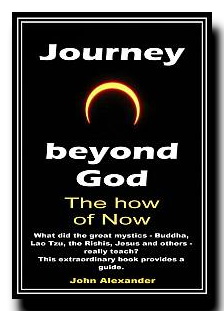
Journey Beyond God

Now published on Buzzword: John Alexandra's remarkable book, Journey Beyond God takes the seeker beyond the usual religious conventions and the 'God' invented by fearful humanity to the underlying secret behind all transformational systems. Subtitled The How of Now, this is a practical guide to mysticism in all the great traditions. Here is a brief sample from the start of the second chapter.


APPROACHES TO THE SECOND WORLD


The only aim of spiritual exercises is to gain control of attention.
 Ramana Maharshi

 Yoga is constraint placed upon the variations of consciousness. Then he who sees is present to himself.  Otherwise, he remains identified with the variations.
Patanjali


Do you remember yourself when you were three?
    Moss by a mountain stream. A dewy rose in the sun. And an open-hearted child. Sheer exultation of being.
    The child sees the world as a miracle iridescent with possibilities. It sees trees praying to the sky, grassfields bowing to the wind. Even the thin peal of a schoolyard bell leaves a timeless shiver in the air.
    And are its clouds of glory a half-remembered thing? Is its heart's heart linked to a unity known before birth?
    Remember your first freshness? What a wonder the world was then. Marvels jostled to reveal themselves and somewhere everything was in tune.
    Before grim knowledge spoiled you, Odyssey's called you on the wind and the song of your blood became perception. You breathed elation's sacred air.
    An infant's thought-unclouded eyes can be as fathomless as the glaze before death - enough to agitate its parents into self-reinforcing baby talk. The child knows nothing and everything - as if it's not a child at all. So to teach it to be one becomes every parent's task.
    As an infant, we saw directly - a discernment not easily found. We were well informed for a creature so recently born. So were we completely infants? Or potentials facing a new experience?
    Some believe death thrusts us back into the morning of our lives and cite child prodigies as proof that expertise is transported through the womb. Some see lives as fixed roles that, like actors, we are obliged to play out.
    We can be diverted for a lifetime by such theories. But theories don't feed hearts.
    In the brief years before thought's pale cast enveloped us there was freshness of perception. Why?
    Because life was filtered entirely through our senses and instead of 'thinking' we experienced. And because we received impressions directly, everything was vivid.

Tuesday, 24 July 2012

Who Wrote the Plays of Shakespeare?

The late Joy Lonsdale was much intrigued by such matters. Here, found among her papers, is a commentary followed by an extract from a letter sent by one of her many academic correspondents. Buzzword posts it for your interest. (As for us - do we have an opinion? Only that if Shakespeare wrote the plays, he was assisted by others with great wisdom who interpolated profundities and ensured that they were uttered from the mouths of dolts such as Polonius. There is the long tradition of the fool at Court generally being the most perceptive person. But we digress.) See what you can make of this yourself:


My English friend and I have lately been discussing Gurdjieff and his numerous made-up words, such as "Trogoautoegocrat", which is based on four Greek roots, and he happened to mention that they were not quite as incomprehensible as "Honorificabilitudinitatibus" which appears in Act Five of Love's Labour Lost. Probably not too many people would even bother trying to work it out, and it certainly can't be done in the simple way that "Trogo…" can, for it is far more complicated, and a perfect anagram. Rather than retype it all out here, I will enclose a copy of part of Roy's letter dealing with it. What I find interesting is the mention of R. M. Bucke, who it seems was in the pro-Bacon camp.

Incidentally, Francis Bacon was a Rosicrucian, being at one time Imperator of the Order of England. This, to me, explains the Fr. in front of his name, which is short for Frater rather than Francis.

They also state that many scholars now believe from their researches that Bacon was the author of the "Shakespearean" plays, and that the Rosicrucian history states that he was also the author of the Manifestos, which brought about the revival of the Order in Germany in the 17th century.

This is debatable, for it is also thought by some that Johann Valentin Andreae wrote them under the influence of John Dee. (No one has ever claimed authorship, once a very common procedure for knowledgeable men imparting a teaching. They have no need of fleeting fame, or for the more prudent reason of avoiding a stake or the chop!)

So far, I have not come across Dee ever being mentioned in Rosicrucian literature - most likely because of the stigma of charlatan undeservedly attached to his name.

Francis Yates maintains that he was a Rosicrucian, albeit secretly ( as most were) because of the threat of the heresy charge in those days. He cleverly invented a doppel-ganger named Edward Kelly, on whom he could heap any blame if accused, but it backfired on him.